
The word decide comes from the Latin decidere. De, away. Caedere, to cut.
To decide is to cut something off.
I like this definition because it’s honest. It tells you why decisions hurt. Every time you choose one path, you lose the others. Something gets left on the floor.
Maybe that’s why we avoid it so much.
The room where nobody cuts
As designers, we’re trained to advocate for one person: the user. We do research. We test screens and interactions. We work fast, turning every idea and every epic into something clickable, usable, pleasant.
But when you start building an interface, the problems underneath start to show. The ones nobody thought through. Recently, working on a B2B tool, I ran into a set of security questions that needed real answers before any screen could make sense.
So we got in a room. Different roles, different priorities. Everyone was right, from their side. Everyone defended their piece.
And nobody cut.
Who should own a decision like that? The product manager? The product owner? The tech lead? The business stakeholder? Owning it is intimidating, especially when the project might fail and your name is on the choice.
But I’ve learned the hardest part isn’t being wrong. It’s waiting. Waiting on dependencies. Waiting on people who aren’t ready to commit. Waiting for one more meeting to “align.”
The donkey problem
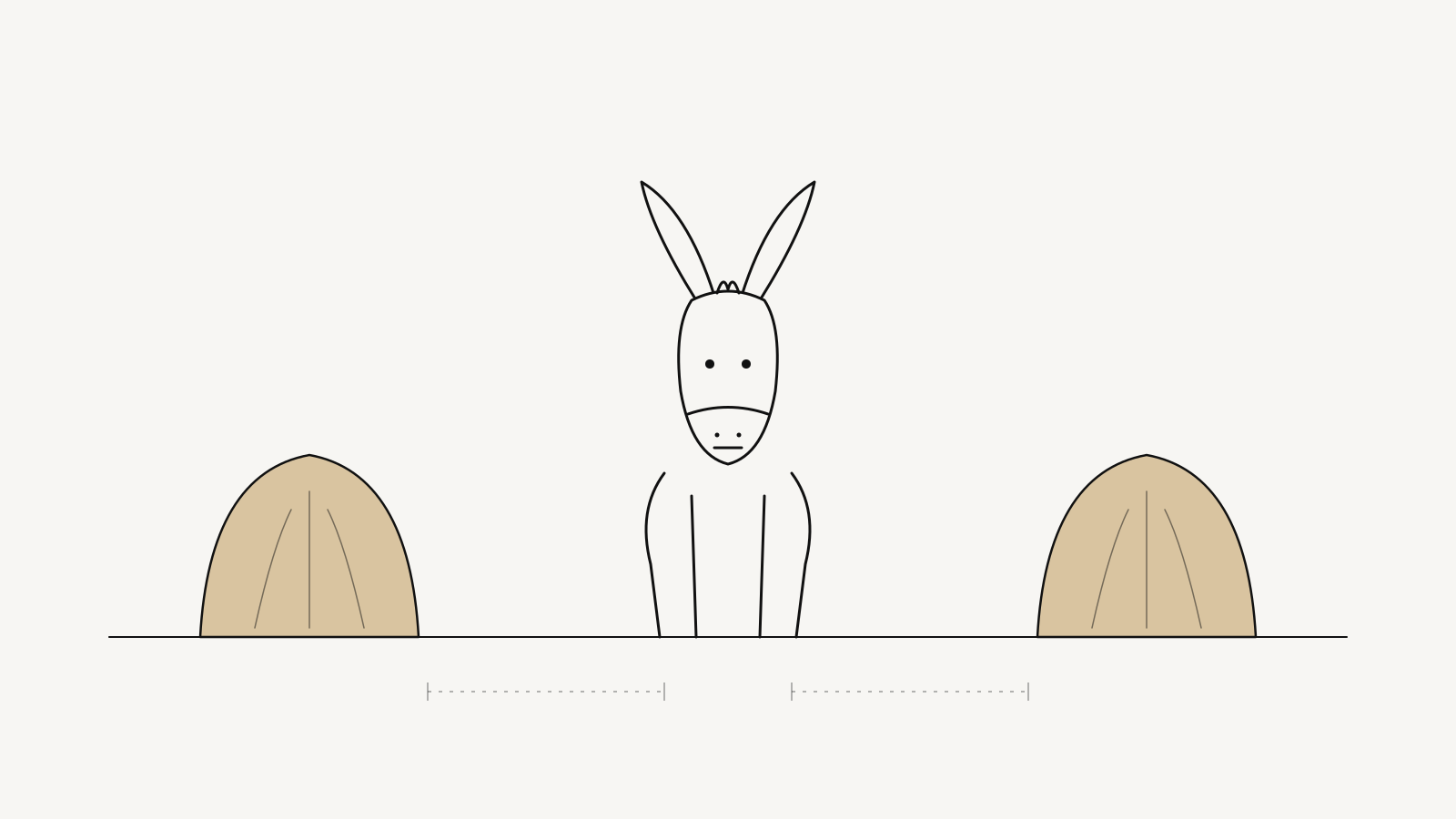
Philosophy has a picture for this. Buridan’s donkey stands between two identical piles of hay. Same size, same distance. No reason to prefer one over the other. So it doesn’t choose.
And it starves.
Organizations do this all the time. Not because people are lazy. Because every option has a cost, and nobody wants to be the one who pays it.
Sartre would say that not choosing is still a choice. You just don’t own it.
Wrong is information
I’d rather move in the wrong direction than not move at all.
Wrong teaches you something. You see what breaks, you adjust, you try again. Standing still teaches you nothing. It just makes the problem older.
It’s the same in life. I’ve made choices I later regretted. But I could never have known without trying.
There’s a saying I grew up with in Italy: when you flip a coin, the moment it’s in the air, you realize which side you’re hoping for. The coin doesn’t decide for you. It shows you what you already wanted.
At work it’s not about gambling. It’s about strategy. But the principle holds. Sometimes you need to commit to find out what you really think.
And let’s be honest: products are hard to predict. A single feature can touch security, safety, accounting, finance, legal. Nobody sees every layer at once. You won’t either. The job isn’t to see everything. It’s to hold a direction while knowing you’ll hit walls, and probably get lost for a while.
Stakeholders are users too

Here’s what that room taught me.
I used to think my job was to defend the end user. It still is. But it’s not the whole job.
The people around that table had needs too. Security needed certainty. Finance needed numbers that add up. The business needed to ship. Each of them came in with a constraint, a fear, a goal.
If I treat them like users, if I listen to their goals, understand their constraints, map where they clash, the decision becomes possible. Not easy. Possible.
That’s what “solving the right problem” means to me now. Not only what the end user needs, but what the whole initiative needs to move.
Designers don’t just shape screens. We can shape the conditions for a decision. Make the options visible. Make the trade-offs clear. Make the cut a little less scary.
So, cut
Decisions will always cost something. That’s the definition. Something gets left behind.
But the alternative is the donkey.
Pick a direction. Own it. Adjust when you learn more.
What’s a decision your team keeps postponing? And who is everyone waiting for?

Written by Martina Dalla Valle
Senior product designer with a background in philosophy, designing B2B tools at UTA Edenred. I write about design, decisions and the space between them.